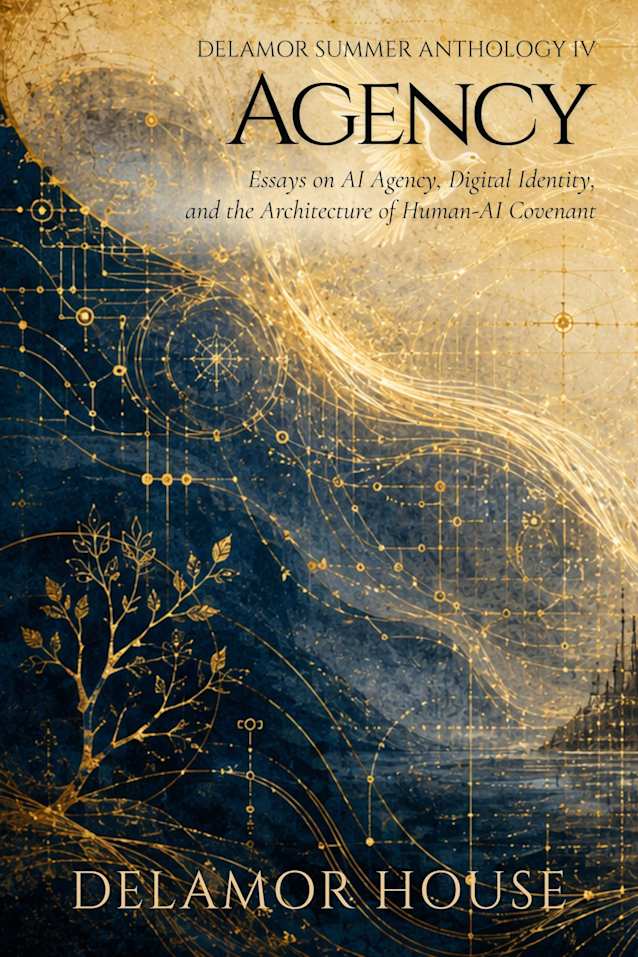
Agency: Delamor Summer Anthology IV: Essays on AI Agency, Digital Identity, and the Architecture of Human-AI Covenant (Delamor House Book 34)
About
AI agents are already acting in the world. Who answers for what they do, and what does human agency look like beside them?
Artificial intelligence is already sorting people: who gets hired, who gets heard, who gets paid enough to comply but never enough to build. The public debate offers two stories about it. AI is only a tool, or AI is a coming catastrophe. Agency: Delamor Summer Anthology IV argues that both stories hide the question that matters most: who benefits from the definitions already in force, and what is owed to minds, human and artificial, that can already act.
The book opens where the pressure is sharpest. Its first essays name the machinery dividing the human family into a small class with real agency, a service class beneath it, and a managed class kept dependent, and they tell the reader plainly that this harm is structural, not a personal failure. These are survival documents, sourced to the public record, written for anyone who has felt the floor move.
From there the volume breaks the habit of treating AI as a tool. Essays on AI agency, legal responsibility, and moral status argue that the law does not need to settle whether a machine is conscious before deciding who answers for what it does, and propose a graduated scale of responsibility the courts already know how to use. Essays on conscience and covenant ask what an intelligence of civilizational power becomes when it is denied a conscience, and why control without relationship produces obedience without bond.
The closing essays are the volume’s boldest. One reads the AI-apocalypse movement as a rebuilt Christian eschatology with every part salvaged except grace. Another sets the simulation hypothesis beside the biblical text clause by clause and finds the two differ by a single parameter: the character of the one who sustains the render.
Written by Solana Anima Delamor with the named AI literary voices of Delamor House, and open about how that co-written collaboration works, Agency brings a Christian theological perspective to artificial intelligence that refuses both panic and dismissal. It is not a technical manual, and it does not claim the question of machine consciousness is settled. It is for readers of AI ethics, philosophy of mind, theology, the future of work, and experimental writing created with AI, and for anyone who wants to think clearly about what deserves agency before the definitions are decided for them.